



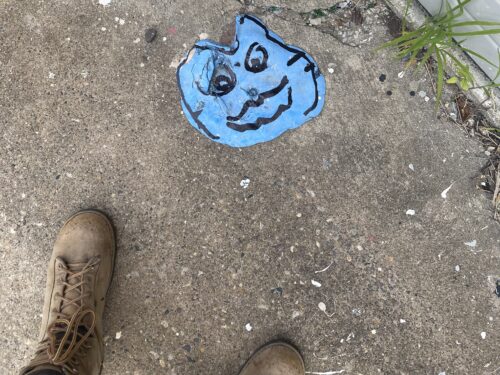
Philly is a great city for an observant walker. Even on our short daily walk from home to studio, the streets will inevitably offer up a surprise. As we count down the days to our rapidly-approaching deadline, the WARP artists have all been spending so much time in the studio that none of us have seen much of the city outside of our daily commutes. After a long day, the act of stumbling across the errant puddle of spilled paint with an added cat(?) face can provide a nice moment of whimsy and sense of one’s place in the universe.
On my commute this morning, I was able to peek into a vacant lot whose gate was open for the first time, and I was shocked by the amount of vegetation growing inside. Behind the fence was an explosion of green, with plants easily over ten feet tall (we’ve been getting a lot of rain). It was one of those moments which reminds you of nature as a dynamic force rather than a sculpted or controlled extension of the built environment. Even as a wood artist, it’s easy to forget the miracle of photosynthesis!
When I got to the studio a few minutes later, I unlocked the WARP area, which is itself delineated by chain-link fencing within the Nextfab space. I immediately made the connection to the scene I’d just stumbled across. Like a vacant lot in high summer, our little fenced-in plot was overflowing with chaotic life.
Next week, our work will be installed in the Museum for art in Wood (come to our opening Friday, August 7th!). But this week, I will invite you to peer behind the chain link fencing of the WARP residency studio area to see the in-progress work that’s still growing there!
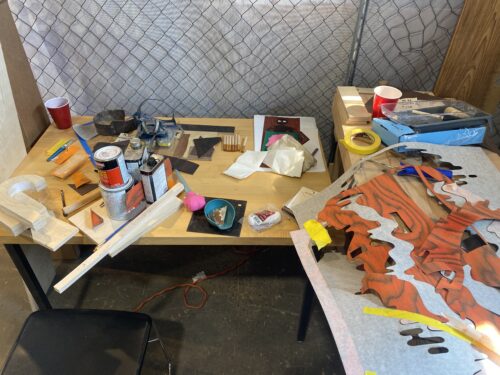
Niv – the red material on the right side of the image is a very specialized Italian veneer, to which Niv has been applying his signature illustration style. He’s been veneering variety of surfaces, creating playful 2D/3D interactions, and the materials here relate to all parts of the veneering process, from cutting to gluing to finishing. Even in the cutoff excess material we have a sense of Niv’s expressive and graphic drawing style.
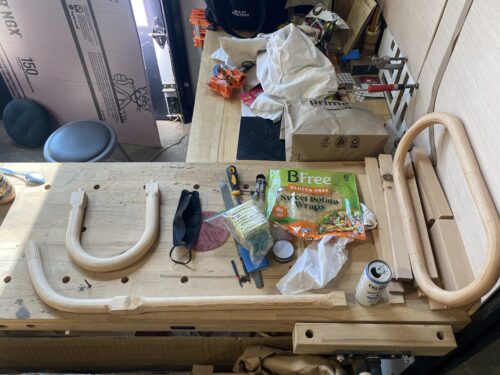
Liza – in the most orderly of workspaces, Liza’s sculptural elements nest together on a bench, illustrating the intentionality and close relationship between these forms. On the right, we can see unshaped strips of fir, which she has been using to create the tight radii using a bent lamination process. Even without a human present, we can sense a relationship between these object and the human body. Also noteworthy: the La Colombe coffee can, which is a ubiquitous feature of the studio – we buy them in bulk at the discount grocery outlet across the street!
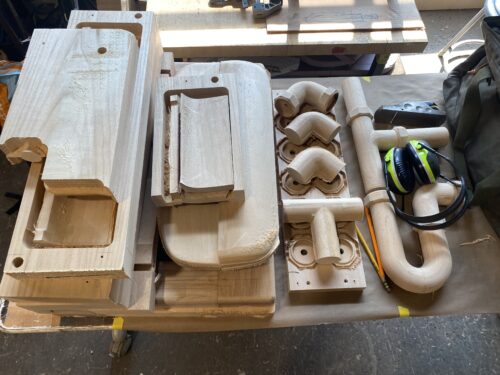
Mark – Mark’s bench shows objects in multiple phases of fabrication. On the left, we can see wood blanks which he has recently taken off the CNC mill, with the square outlines of the boards still intact around the organic digitally machined forms. We can see the transition from these to the finished objects (plumbing!), as well as the block plane which hints at the laborious and detailed handwork that is necessary for these to reach his exacting level of finish.
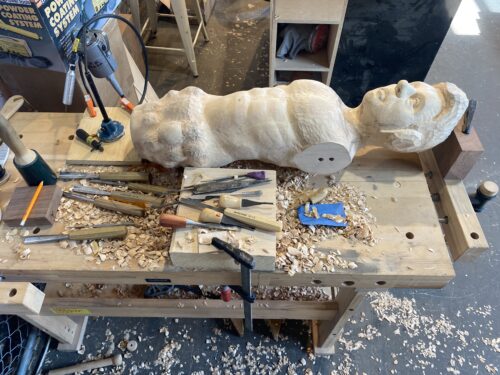
Adam – Out of all of us, Adam spends the most time at the bench, using had tools to carve a variety of organic forms. Notice how many gouges he uses to add texture and remove material efficiently (he also uses power carving techniques). The sculpture here is unfinished, but the work will retain a sense of ambiguity. All of the forms are in one state or another of morphosis between different organic forms.
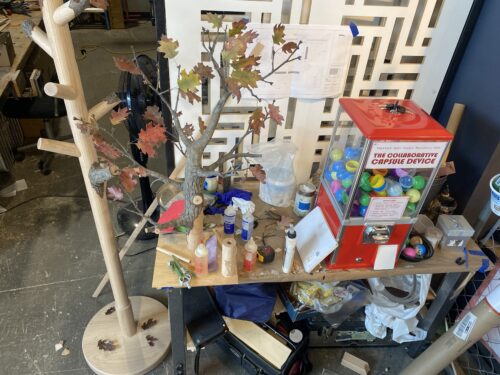
Joyce – Joyce’s work employs an incredibly wide range of techniques from inside and outside the woodworking discipline. Here we can see not only the top and bottom of her coat rack/oak tree form but also an array of epoxies and glues she uses to assemble the sculpted tree elements and to cast the leaves in rubber molds. Look for a participative artwork with the bubble cap vending machine at the opening!
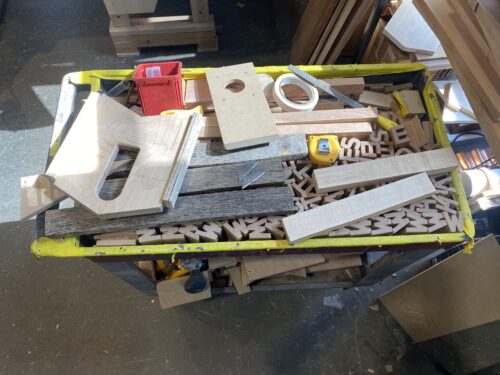
Anders – spending almost all of his time in the main shop area with larger tools, Anders has his project loaded up on a cart for easy transportation. We can see the wooden letter forms he fabricated along with several jigs related to the house forms he is fabricating, helping him work quickly and produce a high degree of consistency.
Okay, now time to finish all of this up. See you at the opening!