

Time passes strangely at a residency. The combination novel experiences with the incremental daily ritual of studio work can by turns make the summer seem expansive and fleeting. Our WARP residency summer has been full of little waypoints: the conclusion of our Bucks County trips, the summer solstice, the end of each round of World Cup play, and now the turn past the halfway point in the our two-month journey.
The WARP Scholar Arrives!
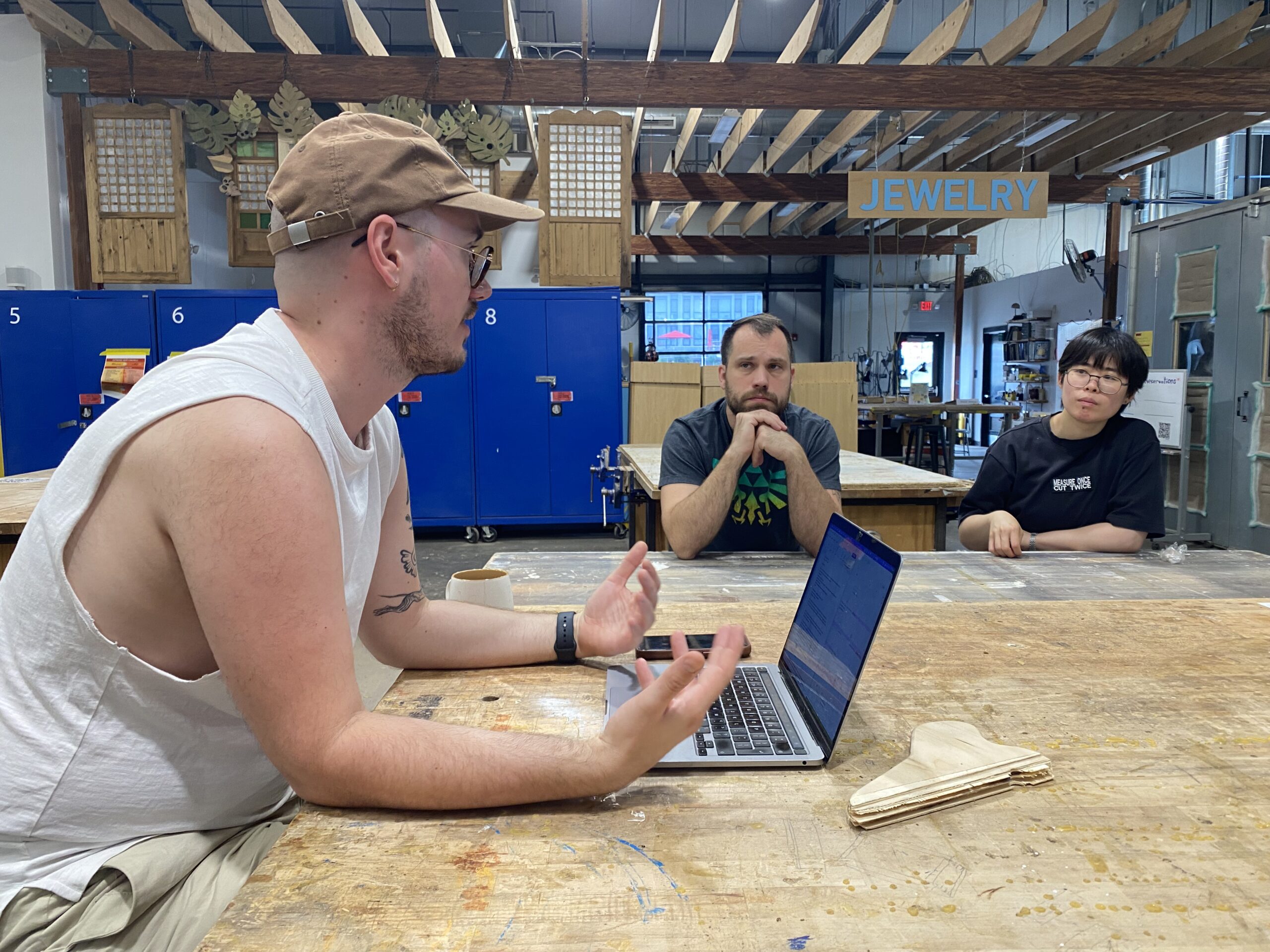
WARP Scholar Daniel Fountain meets with the artists.
Adding to the sense of rapidly-passing time was the whirlwind visit of Daniel Fountain of Exeter, UK, this summer’s WARP Scholar. Daniel is a brilliant writer, thinker, and artist deeply invested in the study of craft, and he became a great friend over the course of his 12-day stay. The purpose of his visit was twofold: in addition to leading his self-directed craft research, including side trips to DC and New York, he spent time with each of us and wrote about our individual and collective practices this summer. The task of finding uniting threads within artists with different practices can be a challenge, but Daniel seemed to easily find the right angle. The halfway-point is a productive time period for these conversations since each of us has enough work to anchor our conversations in the concrete, yet there’s still a thrilling sense of indeterminacy and the potential for change.
Although our friend is already back in the UK, you can look for more collaboration between the Museum for Art in Wood and Daniel in an upcoming Queering Woodcraft exhibition….
Open Studios
The behind-the-scenes view of the WARP residency was not just limited to the WARP scholar, however. Over the past week, we opened our studio area to the public on two occasions, first on Nextfab’s first-Thursday open studio night and then on Saturday for an “official” WARP open studios day. Both events were well-attended by a crowd of curious and friendly art-enthusiasts, and it was really special to see a lot of familiar faces from our past month’s experiences (including folks from Echo Lake, our DC collector visits, and, of course our fellow Nextfab compatriots). It can be vulnerable to show and talk about work before it’s done, but this experience was incredibly positive and left us feeling energized and excited about our exhibition.
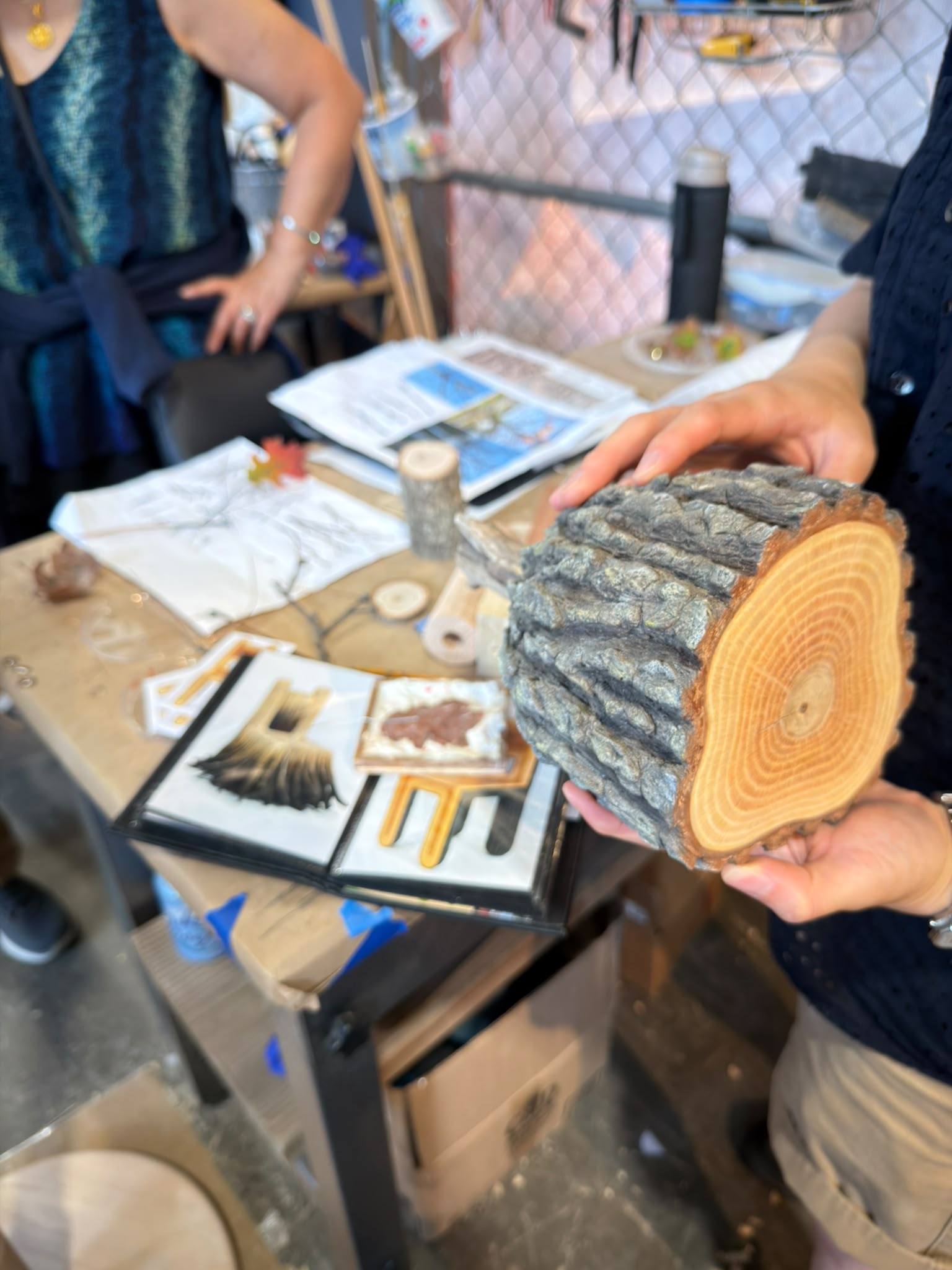
Joyce’s in-progress ham/log sculpture! (Photo by Daniel Fountain)
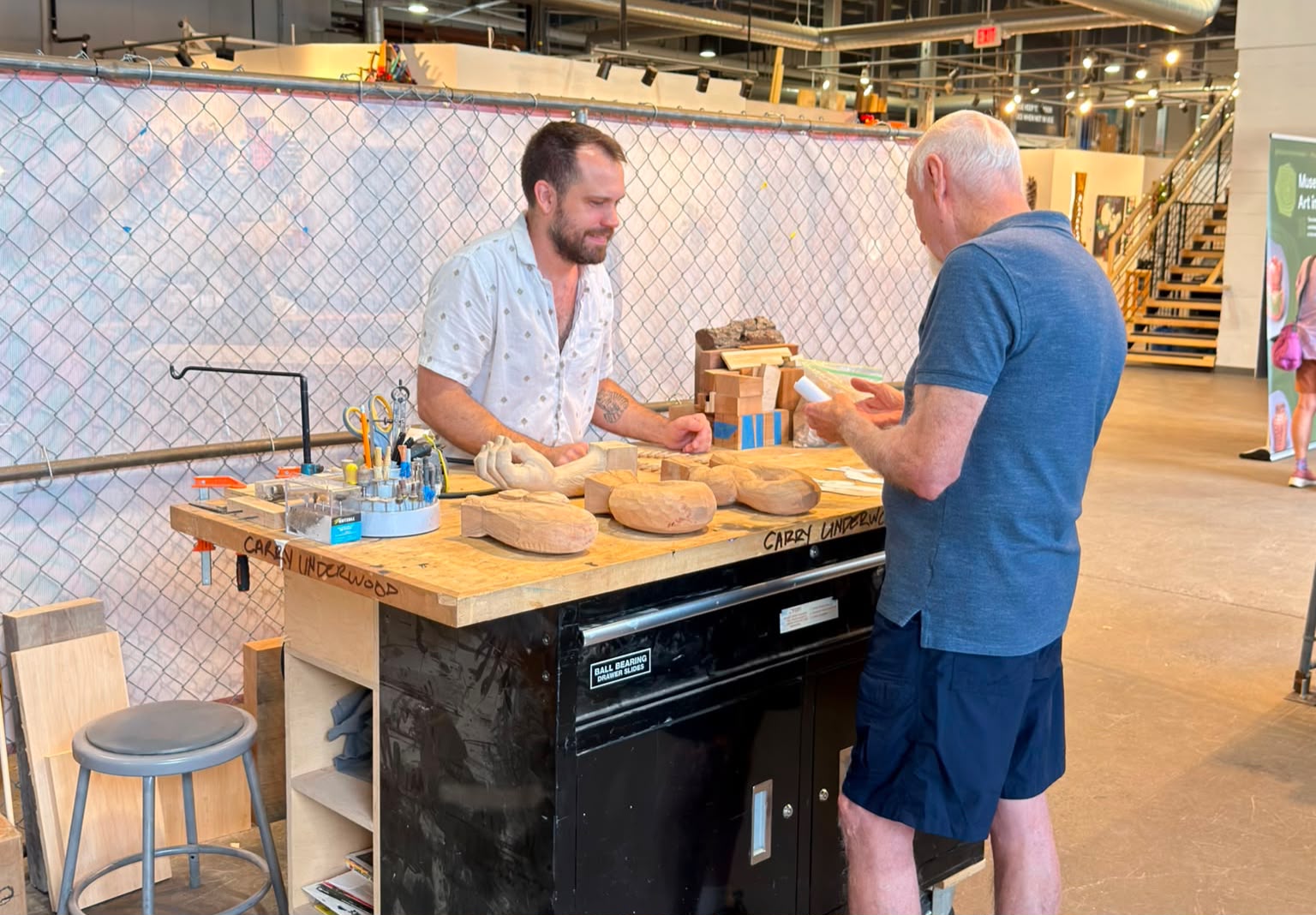
Adam talks with a visitor during open studios. (Photo by Daniel Fountain)
A Name (and an Exhibition)!
One of the challenges of the residency is the balance between planning and being in the moment. Another artist once gave me the advice that, “the point of a residency is to reside.” In other words, to deeply breathe of the everyday experience of being in this place with these people at this particular time. Yet at the same time, we won’t be here in Philadelphia forever, and it takes a degree of planning to make sure materials arrive in time, fabrication steps are completed in the right order, and some (hopefully a lot!) of the ideas in our heads find expression in physical form. It’s a balance!
We’ve heard that one of the biggest challenges residents face is choosing a name for the exhibition. It’s a task that should be simple. It’s just a few words, after all – what could be so hard about that? Yet those few words have a lot of meaning behind them, and they’ll look a lot bigger when they’re printed in vinyl on a gallery wall.
The day before our deadline, we met as a group. We started with a no-wrong-ideas free-association brainstorming session, which got our ideas flowing and got us laughing a few times. After a few rounds of refinement, we found ourselves drawn to a title about “place,” thinking not only about physical location, but also the idea of placement as an artistic gesture. In the end, we chose “Out of Place” as our show title. Colloquially, it’s an expression that relates to a feeling of being literally or metaphorically unsettled. Yet it also relates to the relationship between expectation and reality and the modernist idea of defamiliarization. We’re all making work about places, real and imaginary, that also attempts to do the classic work of “strangemaking” that makes the viewer reassess their world.
An interesting behind-the-scenes note: at first, we almost picked “In Place” as a title. But when somebody said, “What about ‘Out of Place?'” it struck all of us as a better fit. Fascinating how two expressions with roughly the opposite meaning could both work!